Does the NT contradict itself? Does it matter?
 Non long agone, Mark Forest wrote an article in Christian Today exploring the apparent contradictions between the two accounts of Judas' expiry, in Matt 27.three–viii and in Act 1.18. In the commencement, Judas hangs himself, the priests buy the field, and it is named 'Field of Blood' because of the expose past Judas. In the second, briefer account, Judas buys the field first, falls to his death at that place, and it is named 'Field of Blood' considering of Judas' death. These differing accounts take recently become a focus for attending on whether the NT is reliable, and no wonder. Biblical scholar Richard Longenecker believes that the difficulty of reconciling these two accounts is 'ofttimes considered the nigh intractable contradiction in the NT'. Even so this is hardly a new trouble; Augustine was aware of the issue, and it is not much dissimilar from reconciling other differences within Acts itself, such as the iii accounts of Paul'south chat in chapters 9, 22 and 26.
Woods suggests a manner of living with this. Rather than try and reconcile the two accounts artificially, we should accept the 'blindingly obvious' point that there are two different, contradictory stories, and that 'one of them got it right, and the other didn't.'
I don't believe for one moment that the Bible is compromised by honesty near the parts where it contradicts itself or where the biblical writers, speaking spiritual truth in the context of erroneous ideas about science and nature, only got things wrong.
Only there is one rather large trouble with this. If there really are two stories, and they really cannot be reconciled, the logical conclusion is not that one is right and one is wrong—just that they are both wrong since historical reliability (at least in our agreement of the idea) is not important to the NT writers. And if these two stories are not reliable, what near the rest of Acts? Or the gospels? In item, what near the 'contradictions' between the accounts of Jesus' healings? Or the whole shape of his ministry (about v months in Mark, 3 years in John)? Or his trial and crucifixion? Or the resurrection—was there i angel (Mark) or two (Matthew)? Two women or iii? The women first to the tomb, or the men? And did they say nothing, or tell the others…? And so on. If these accounts cannot be reconciled, then the most obvious conclusion to draw is not that 1 of the accounts is authentic and the others are non, but that none of them are. And I don't call back it is so possible to conclude that in matters of religion the Bible is trustworthy, but in the matter of facts information technology is, well, a little chip hitting and miss. The NT documents practice not separate organized religion and facts in this kind of mode.
In fact, Matthew and Luke tell u.s. that they are interested in facts, in their different ways. For Matthew, the story almost Judas has a particular function in his narrative. It is an odd identify for him to include this episode, since it means taking events out of lodge—jumping ahead to Judas' death and so jumping back to Jesus' trial. Luke'due south guild in Acts is more logical. But Matthew does this because he wants united states to spot 3 things: offset, that Judas' fate was a fulfilment of Jesus' words in chapter 26; second, to see the contrast with Peter, and the difference between Peter's repentance and Judas' 'remorse'; and thirdly that all this was a 'fulfilment' of the OT Scriptures. And so he follows upwards the story of Judas with a quotation from Jeremiah. Except that the quotation incorporates elements from Zechariah too, and doesn't actually fit the story very well! Equally with Matthew'south other examples of 'fulfilment' (particular in the birth narratives), the fit looks rather forced. If Matthew was making the narrative upwardly, then he could accept done a much better job—and the logical conclusion from this is that he is making the 'fulfilment' fit the facts, rather than the other way around. The facts do matter.
Luke, in his ain way, is also making this indicate. Having noted that others accept offered their own versions, he sets out to provide his own account from centre-witness research so that his readers might be confident in what they have heard (Luke ane.1–4). In this aside most Judas (which most English versions put in brackets), he includes a puzzling trivial phrase (me oun) which suggests that he is filling out some item for a story that his readers might take heard elsewhere. It looks very much similar he wants to fill in some facts!
To run across what is going on here, let me give you an analogy from my ain experience. I was recently rather late getting to the station for a train, was very hot and bothered as I jumped on and plant my seat. There was no refreshment service on the train, only the person opposite me was very kind and offered me his bottle of water. When I opened my Bible for the reading of the twenty-four hours I found this: 'Truly I tell yous, anyone who gives you a loving cup of water in my proper name because you belong to the Messiah will certainly exist rewarded' (Mark 9.41). Moral of the story? God speaks through Scripture into our situations.
Or another story. I usually bicycle to the train station, just on one occasion hadn't done so for several weeks. The night earlier I thought to myself 'You actually ought to cheque the cycle.' But I couldn't be bothered and left information technology till the morning. When I got the bike out, disaster—information technology had a flat tyre! I pumped it up, cycled like the current of air, and arrived at the station as the railroad train pulled in! Moral of the story? Ready alee of fourth dimension—though even if you don't, God volition provide a way.
In fact, those are two stories about the same result—but yous'd be hard-pressed to tie them together, not least considering the two trains mentioned were not the same, but connecting trains, and the full story wouldn't quite agree with either. So the question might arise: what was the true story of my journeying that morning? When we tell stories, nosotros edit them and condense detail in order to draw out a particular bespeak, and this is the way that the gospel writers use their material—often in an even more condensed style, since they employ many fewer words than we would today.
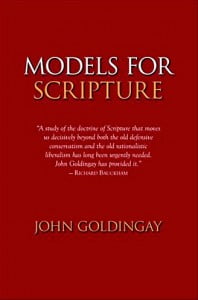 This points to something essential about the nature of Scripture. To talk of Scripture as 'inerrant' might fit if information technology were just a rule book, or a car maintenance transmission—but information technology is neither, and to that extent I agree with Mark'south view. In his Models for Scripture, John Goldingay points out the different means that Scripture talks of itself. One of these is as 'witnessing tradition'—a testimony to what happened passed downwards faithfully to others. As a 'witness', the accounts of what happened have been edited, to describe out a point—the main one being that in Jesus, God has come and redeemed the earth. But testimony always have to have a facticity virtually information technology; information technology has to offer a coherent account if information technology is to exist taken seriously as a reliable witness. This comes back to something Mark Woods says early on in his reflection: 'It's true that logically, there's nothing impossible about this manner of reconciling two stories.' And for me, it is vital that this is possible, even if it not the first thing that I want to do with these texts.
If they cannot be reconciled—if they are not at some level reliable accounts of what happened—then they are non a credible witness. And if they are non, then they cannot tell me the truth about Jesus Christ.
A version of this commodity was published in Christian Today on 3rd Oct 2015
Follow me on Twitter @psephizo.Similar my folio on Facebook.
Much of my piece of work is done on a freelance basis. If you have valued this mail service, would yous considerdonating £1.twenty a month to support the production of this blog?
If you enjoyed this, do share it on social media (Facebook or Twitter) using the buttons on the left. Follow me on Twitter @psephizo. Similar my page on Facebook.
Much of my work is done on a freelance basis. If you have valued this post, you can brand a single or repeat donation through PayPal:
Comments policy: Proficient comments that engage with the content of the mail service, and share in respectful debate, tin add existent value. Seek first to understand, so to be understood. Make the well-nigh charitable construal of the views of others and seek to acquire from their perspectives. Don't view debate every bit a conflict to win; accost the argument rather than tackling the person.
dickersondawas1976.blogspot.com
Source: https://www.psephizo.com/biblical-studies/does-the-nt-contradict-itself-does-it-matter-2/

Post a Comment for "Does the NT contradict itself? Does it matter?"