Reading Revelation 1–3
 If y'all make use of Scripture Union'southEncounter with God Bible reading notes, and so you will have been reading through Revelation 1–3 this week. (If y'all don't, why not subscribe?) Hither are the comments I wrote on these capacity; for more detailed comment, see my Grove bookletHow to Read the Volume of Revelation.
Revelation i:1-xx: A kaleidoscopic vision
How practice you 'come across a voice' (v 12)? From the very beginning, the book of Revelation challenges our assumptions and breaks down the categories we wish to box it in with. Information technology is a vision, but it is something that John both sees and hears (vs x, 12), and this boggling kaleidoscope of imagery is in fact 'the discussion of God and the testimony of Jesus' (5 2). And although John has a vision, what we now have is a vision report, an extraordinarily beautiful, crafted and intricate piece of writing. We will need to read and listen advisedly to hear its bulletin!
All the way through, John presents the states with things with which we are familiar – merely in a surprising way. Information technology is a letter, the opening greetings (vs 4,9) reminding u.s.a. of Paul's letters. But it is also a revelation (apocalypse 5 one) and a prophecy (five 3) which draws us into praise and worship (vs 5b and 6). Circumspect listening volition offer insights that we could not otherwise know, give us a distinctive understanding of God'due south perspective, and draw us into a response of offer ourselves afresh to God.
John is clearly a pastor, who knows his congregations well and shares with them the hope of the kingdom, the hardship that being faithful to Jesus involves, and the endurance that is needed to hold reality and hope together (v 9). He sees the realities they face, but makes sense of them by drawing on the full range of the Old Attestation scriptures—scriptures which indicate to the centrality of Jesus, who is the one who makes God known to us. He is the ane who sees and judges truly, and he is the one who holds his people secure. This is truly a 'revelation of Jesus Christ' (v 1).
Rev two:ane-eleven: Within Matters
Given the earlier design in Rev 1.i (God, Jesus, his angel, John, the reader, the hearers), the affections (v 1) is best understood as the one who can communicate God's message to his people, rather than representing the spirit of the congregation. In these ii capacity we read non letters (the whole of Revelation is a letter) only royal pronouncements from the ane on the throne, declaring affirmations, rebukes and challenges, and property out a hope (5 7). The white light of the vision of Jesus in chapter 1, is here split, as if past a prism, into a rainbow of attributes, each pertinent to the advisable congregation.
Ephesus was a eye of wealth and civilisation, the second metropolis of the Empire at the time. The congregation in that location had much to commend it: committed and ready for hard work having persevered through hardships. It was discerning, having obeyed injunctions to 'test everything' (1 Thess 5.xx–21, one John 4.i) and rejected the Nicolaitans (five 6), whoever they were. Yet duty had extinguished joy; hard work had displaced warm beloved; perchance fifty-fifty the things of God were of more interest than God himself. Outwardly they looked good – inside something was incorrect. They needed to rediscover their first dearest for the one who walked amongst them (5 one) if they were to enjoy life in all its fullness.
By contrast, those in Smyrna were non fooled past outward appearances (five nine). Though their metropolis was known equally the Crown of Asia and held prestigious games, they knew that there was only one wreath worth competing for. Though others judged them, they knew that only one person's judgement counted. And though struggling and on the point of death (v 10), their faith was in the one who had conquered death (v 8).
 Rev two:12-17: Dangers inside and without
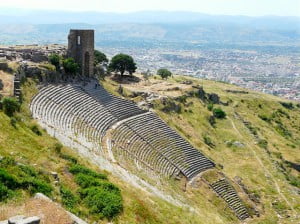
The congregation at Pergamum (modern Bergama) faced serious challenges, from within and without. Commentators take speculated that the 'throne of Satan' (v thirteen) alludes to the appearance of the hill on which the upper city sits, or the shape of the temple to Zeus. More likely information technology refers to Pergamum being the centre of Emperor worship. The challenge here was living in a culture and an ideology systematically opposed to the Christian claim that Jesus – not Caesar – is Lord.
The second kind of opposition was more direct. We know nothing more of Antipas than this mention, though he was non the terminal in Pergamum to die for his faith. In 'not loving his life so much as to shrink from death' (Rev 12.11), Antipas (v 13) is following in the footsteps of Jesus the 'faithful witness' (Rev 1.5) — and introducing a new clan between witness and death in the word 'martyr' (v 13). The Christians here take withstood these external pressures, merely have washed less well resisting internal ones. 'Balaam' (v 14) alludes to Numbers 31.sixteen; the prophet couldn't follow Balak's command to speak directly confronting God's people, but defeat came indirectly, through their susceptibility to temptation. We know cipher of the Nicolaitans (five xv) or even whether they were an actual group. But the name suggests 'victory over the people', and it is their inner weakness which has caused them to stumble.
Merely it is Jesus, and non the emperor, who holds the 'double-edged sword' of truth, the word spoken from his oral cavity (vs 12,16). He is the true victor, and the ane who rewards those who share his victory. He sustains his people, as they were sustained in their desert wanderings; information technology is he who knows our truthful proper name (v 17), that is, our character. He knows both our trials and our needs.
Rev ii:18–29: Truthful prosperity
The longest and virtually complex of the seven letters is addressed to the city about which we know least. What nosotros do know is that coin mattered in Thyatira. This was 1 of the start cities to use coins, and as it was not in a stiff position militarily, it relied on merchandise for its prosperity and importance. It was on major trade routes north and southward, and in Philippi Paul met Lydia, a cloth trader from the city (Acts xvi:14). With merchandise came trade guilds which were as much religious organisations as they were economic, each having their own gods. So protecting i's prosperity often meant a compromise in belief. To change religious affiliation always had economic consequences, as the Ephesians discovered (Acts nineteen:23-41).
Jezebel (v 20) was the wife of Ahab and curvation-enemy of Elijah and Elisha (1 Kings 16 to two Kings 9). She was never accused of sexual immorality, just of leading God's people to worship other gods, so we demand to read the language of sexual immorality here as a metaphor for being unfaithful to God – as used by Hosea and other OT prophets. Jesus' judgement (vs 22, 23) sounds severe, simply needs to be read in the context of Revelation'south imagery. His warfare is with the sword of his mouth (5 sixteen) and brings about the death of false claims. Striking 'her children dead' (v 23) means that Jezebel'south post-obit will not concluding.
To those who take connected in 'love, faith, service and perseverance' (v 19) nothing more than is needed. Echoing a letter in Acts (Acts 15.28), the message makes clear that there are no start and 2d class followers of Jesus. To all who stay true-blue, the reward is to non just share in Jesus' authorization (v 27) but to share in Jesus himself, the 'morning star' (5 26, Rev 22.16).
Rev 3:1–13: Wake up! Concord on!
Today nosotros read ii contrasting letters—one contains little praise (vs one-6), and one contains no rebuke (vs 12-13). They are addressed to two contrasting cities besides. Sardis was aboriginal, prestigious and proud. It had been the seat of Croesus, the king of legendary wealth. Its upper city (acropolis) was so impregnable it had never been taken by force. Simply it had been taken twice, by stealth. The citizens were so sure of themselves that they posted no night watch. When the enemy noticed someone coming out of a subconscious back door, they used that route to take the city whilst the people slept. Three hundred years afterward, another enemy read the account—and the same affair happened. The people were still complacent and sleeping!
'Wake upwards!' calls Jesus (5 2). Organized religion is not about resting on your award, thinking that your upbringing, track record or reputation will keep you safety. It is about walking with Jesus daily, and heeding his call to holy living.
By contrast, Philadelphia was the newest of the seven cities. Like others, it was devastated in an earthquake in Advert 17—but the people remained fearful, continuing to live in the surrounding fields rather than return to the city itself. In the light of the fearfulness of opposition from Jews who had not received him, Jesus himself reassures them. He has placed earlier them an 'open up door' (v eight) which commonly ways an opportunity for mission (ane Cor xvi:9, 2 Cor 2:12, Col 4:3); not only will the opposition cease, only the opponents will themselves come to acknowledge Jesus (five ix)! As they concur on to God (v eleven), God volition concur on to them; whatever threatens to shake them, God will make them an unshakeable part of his temple, where he himself takes up residence (5 12).
 Rev 3:14–22: How to make God sick
This message is peradventure the best-known of the seven – and the most misinterpreted! To u.s.a., beingness hot or cold is about beingness passionate or indifferent about faith, hot beingness good and cold being bad. Simply would Jesus prefer us to exist common cold than to be lukewarm (5 fifteen)? Does that brand whatever sense? Is open up antagonism to faith better than half-hearted acceptance?
To hear this as John'south readers would have heard it, we demand to visit Laodicea. Founded in the third century BC, it was (similar Thyatira) a commercial rather than military city. Cicero knew it every bit a banking centre but information technology was also famous for textiles, especially a cloth made from sleeky black wool. Its medical school produced ear ointment and center salve. The metropolis was and so proud of its financial independence that it refused imperial help for rebuilding after an earthquake in AD 60. No wonder they thought they were rich, well clothed and had proficient eyesight (5 17)!
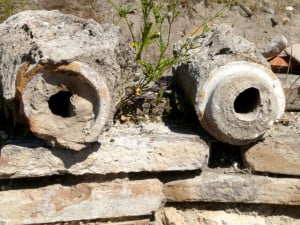
What they did non have was a skilful water supply. Colossae, further upwards the Lycus valley, was known for its cold springs. Hierapolis, across the valley, had hot springs and was a centre for healing and organized religion. Merely Laodicea's water was from hot springs farther upwardly the mountain. By the time information technology reached the city it was lukewarm and full of calcium deposits—enough to brand yous throw up if yous drank information technology! Cold h2o is good for refreshment, hot water for healing, but lukewarm h2o is adept for cypher—but like the Laodiceans (v 16). Jesus' criticised their works not their faith (v 15). Their complacency meant that the grace they had received was not being translated into activeness to transform the globe around them. Yet Jesus still loves them; he all the same offers to come and sit down with them and put things right – if invited (5 20).
Much of my work is done on a freelance basis. If you have valued this post, would you consideraltruistic £i.20 a month to support the product of this weblog?
If you enjoyed this, practice share it on social media (Facebook or Twitter) using the buttons on the left. Follow me on Twitter @psephizo. Like my page on Facebook.
Much of my work is washed on a freelance footing. If y'all have valued this post, yous tin make a unmarried or repeat donation through PayPal:
Comments policy: Good comments that engage with the content of the post, and share in respectful debate, can add real value. Seek first to sympathise, then to be understood. Make the most charitable construal of the views of others and seek to learn from their perspectives. Don't view debate as a conflict to win; accost the argument rather than tackling the person.
dickersondawas1976.blogspot.com
Source: https://www.psephizo.com/revelation/reading-revelation-1-3/

Post a Comment for "Reading Revelation 1–3"